Thoughts
This is where I put my thoughts. Here's a link dump of organizations I go to for information.
Focusing is Difficult
I promise that I haven't been not writing since the last time I posted here. There are like three half-articles in the google doc I use, but the ideas for all of them are all mostly dogshit. Anyway, I just wanted to write on an issue that is much more salient to my generation (Gen Z): non-stop entertainment.There are so many ways for me to spend my time on my laptop. It's actually fucking crazy, so I'm going to list out as many things as possible right now:
- Watching old and new "Hot Ones" episodes
- Reading through incredibly long wikipedia pages
- Scrolling through X, Reddit, or Instagram
- Watching pirated TV shows or Movies on tens of platforms that provide 720p videos of complete sitcoms all the way back to the 2000s
- Play any .io game
- Play Minecraft
- Reading random pdfs of books about topics that I have a transitory interest in
- Texting my friends on Imessage, WhatsApp, Instagram, Discord, Signal, or X
One way to potentially increase my attention span and to really hone in on one "thing" is to increase the cost of engaging in a thing. For example, I shouldn't be allowed to just switch between multiple different optimization textbooks. I should do some low-depth searches, find an okay-ish textbook, and regularly read it and self-study from it.
However, there's an issue to increasing the cost of engaging with a subject. If I can somehow self-discipline myself into this regime, I might just reduce the amount of searching/perusing I do at all! This would be bad since I would just be bored and default to even worse behavior e.g. scrolling through Instagram reels.
The only conclusion I can come to is that I must expand my budget set. That means I need to somehow increase my mental capacity and want to study economics/statistics.
Housekeeping + Economic Theory
I said a month ago that I would start to do link dumps every Monday. I clearly haven’t committed myself to that idea, because it’s pretty stupid! I was having a conversation with one of my friends about the various news outlets we got to for information. He thinks that the NYT and WSJ are “controlled opposition” and he prefers the Economist since he feels as though he’s learning something new. I don’t agree with the “controlled opposition” part, but I do think the Economist is of a different caliber than either of those publications, but all three of them have their strengths and weaknesses. One thing that I think is true of all of them is that mass-consuming them–like with Instagram reels–is painful and makes you feel like shit.Creating is ALWAYS better than consuming and that provides me with a nice segue into a new tradition that I want to start. Every Friday, I want to write about a cool economic model that’s either made by me or a corollary of one I found in a paper, present it, and deliver some clean insights from it. Modeling Fridays??? Modeling Mondays has alliteration going for it, but I’m too lazy to do that every Monday. I know that the flow of time I receive to produce such a post is the same, but Mondays are a day that I, alongside Garfield, deride, so Fridays it will be. https://meanfieldzane.substack.com/p/modelling-mondays-iv-investments
I might broaden the set of allowable types of posts in the future, but economic theory is a thing that’s been on my mind and, in particular, I don’t think I’m as good at utilizing it as I would like to be.
One thing I love about mathematicians is how systematic they are in defining the life-cycle of a student of mathematics. I’m of course referring to the wonderful concept of “mathematical maturity”: the attribute that every mathematician covets. Here’s an excerpt from Tao’s blog about the three stages of mathematical maturity phrased in terms of mathematical education. I removed some sentences for brevity.
2. The “rigorous” stage, in which one is now taught that in order to do maths “properly”. The emphasis is now primarily on theory; and one is expected to be able to comfortably manipulate abstract mathematical objects without focusing too much on what such objects actually “mean”. This stage usually occupies the later undergraduate and early graduate years.
3. The “post-rigorous” stage, in which one has grown comfortable with all the rigorous foundations of one’s chosen field, and is now ready to revisit and refine one’s pre-rigorous intuition on the subject, but this time with the intuition solidly buttressed by rigorous theory. The emphasis is now on applications, intuition, and the “big picture”. This stage usually occupies the late graduate years and beyond.
The second or “rigorous” stage is probably the longest since it requires learning enough economic theory and empirical methods to grasp most modern economic research. I am at this stage right now and it’s pretty fun.
The last stage, which I think ought to be named something a lot cooler, is the stage where you realize that, as an economist, your main constraint isn’t your mathematical ability, but your competence in (1) identifying interesting questions about human behavior (2) developing theory & finding good data towards the goal of (3) making a robust argument about why things are the way they are and how they ought to change. All of this requires an incredible understanding of mathematics, statistics, law, history, and sociology.
I think this is where the analogy to the idea of mathematical maturity really fails. Or, at the very least, some delineation is in order. To be a great mathematician, you need to be creative, but maybe not in the same way an economist would be. A mathematician is a machine that tries to put together the logical puzzle pieces in just a nice enough way, so that an outstanding conjecture becomes trivial. This is done by genius insight, brute force, or a mix of both!
To be a great economist, you need to be able to take human behavior as it is (complicated) and do everything in your power to make sure that others aren’t deterred by the mystery of it. An economist is another machine that tries their very best to institute order in the study of humans. This is done by genius insight, brute force, or a mix of both!
This is sort of cringe reading it back, but I should be allowed to be cringe on here!
The Glade
Berkeley’s Memorial Glade is such a calming spot. I’m currently sitting on the grass where I just finished my Farmer’s Crepe from La Crêpe à moi, while listening to an episode of Conan O’Brien’s podcast.To finish up all of the nutella that came with my meal, I strategically swiped my fingers at the most nutella-dense parts so as to not scare off any potential observers. However, I realized that, even though I’m out in the open, I have the perfectly optimal level of privacy. I can do as I please and I can even use my hands to eat!
I feel like a stranger to my onlookers, but I’m at home when I’m here. The breeze is hugging my face. I love it here.
Trump’s opinion piece for the WSJ
John Cochrane’s commentary.[...]
Trump’s tariffs are always an answer with five questions, and the foreign policy angle is interesting. The threat of tariffs has made many countries jump on foreign and security policy questions. Not always to Trump’s advantage. Without tariffs, the Conservatives would surely have won the last election in Canada.
“..expanding our military alliances into the realm of economic security” is a fascinating line. Tariffs combine with industrial policy to think of the economy as pieces in the giant geopolitical chessboard. “Economic statecraft” is a big theme of my national security colleagues here at Hoover, which we enjoy debating.
[...]
More importantly, in the economic statecraft angle, we have now bludgeoned allies to do our bidding and carve up markets. They are hurting from the humiliation, and see a more dog-eat-dog world. When China blockades Taiwan, we will want to call them up and say “we really need your help to enforce our sanctions on China.” Will the Europeans, Canadians, and Latin Americans really forsake profitable trade with China to help us on that geopolitical quest? Sometimes flowers and chocolates are better than a big stick.
Surely, someone’s created a model of tariff retaliation dynamics? The model would really only be illustrative, but the hope is that it would help ground my thinking.
Anyway, a set of doom and intellectual despair is currently setting on. How do economists “respond” to this? Making the full-frontal case for globalism and free trade doesn’t really work for even our allies/partners. On the same hand, is Trump right? To clarify, I mean national security and statecraft. My emotions are telling me that he partially is, but it’s hard to make the rigorous case for, say, tariffing Chinese EVs or export controls for particular GPUs.
Last thought, but this paper from HBS was linked in the oped. I know almost surely that Trump is not the reason for it being included, but it’s a really interesting project since they’re the only serious organization keeping track of the tariffs.
I haven’t written for this blog in a while, so I’m going to keep this pretty short. I probably have more thoughts, but I feel so incapable of writing them down.
Festival of Progressive Abundance
I traveled to LA for something called the Festival of Progressive Abundance.The drive down to LA was pretty fun. It was somewhat stressful since I had to complete my ECON 201B (game theory) problem set, but, otherwise, the vibes were immaculate. One nice part of the ride was that we put on a podcast we all seemed interested in. We then took turns pausing it to either ask questions or to start a discussion. The traffic was fucking unbearable though as soon as we got into LA county. Surely, someone’s written about this since there has to be some sort of solution.
Anyway, here are my thoughts on the actual “festival”. First off, it was completely dogshit. It was run by Steve Boyle who’s the most liberal man in existence. Not that that’s really a negative or positive, I just needed to mention it.
Regardless, the event spanned 3 days, but it felt so chaotic and weird and I hated every part of it. 40 people showed up and half of them were students (and we all came together) and the other 20 were adults who had nothing better to do and like Scott Weiner. There was no real schedule and people (including myself) just left whenever they pleased which really killed the vibe. This was more so a consequence of a lot of people thinking this event had zero value, so they were technically acting rationally.
Apparently, Maxwell and Victoria (of Students for Abundance ) want to host a conference this Fall and were also taking mental notes of this experience. To clarify my own thoughts, I’m going to try and succinctly list some things I wish were better about the conference and potential fixes.
- Higher quality moderation. There were some panels that just had shitty moderation.
I’m exaggerating of course, but it feels clear to me that a lot of people that are wary of “corporate power” are also wary of people that espouse more economically liberal ideas or are in opposition to stuff like rent control. Also, why would Abundance want to be aligned with a specifically ideological legal movement that doesn’t necessarily seek to improve consumer welfare, but wants to use the FTC for ill-defined political and social aims?
I think there’s a lot of ways that Progressives, moderates, and neoliberals/rightists can get along, but that way isn’t to somehow forget the last 4 years of Biden’s administration and somehow think the Progressive position on antitrust is in any way grounded in economic literacy. To clarify, one can like Lina Khan’s more activist FTC, but you can’t do so on more economically moderate grounds. Abundance is trying to rebuild the more sane policy wonks that do care about basic economic principles and we should be proud of that.
Dataset on GDP of Indian States
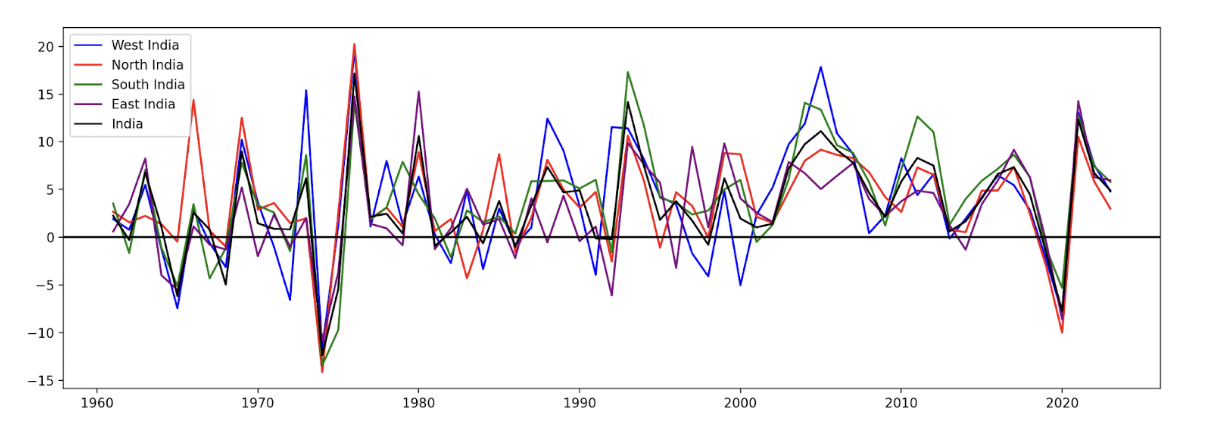
Nick Shankar (4th year econ Phd student at Berkeley) compiled historical data on (nominal) GDP per capita in India AND various states & subregions. The two plots below are for the raw data (gdp per capita) and year-over-year growth.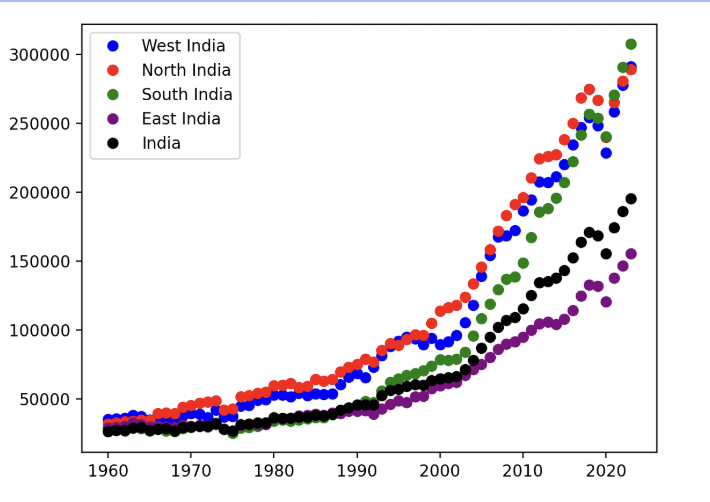
For gdp capita, it is useful to note that GDP per capita of India is equal to the sum of GDP per capita (by subregion) and then weighted by population shares. This is to say that East India is the (relatively) more stagnant part of India
Vivek Ramaswamy
First off, I failed at my goal of creating a slightly more high-effort link dump post this past Monday. I’ll make one next Monday and try to write a lot more to compensate for the fact that the last time I wrote anything here was two weeks ago. Yikes.Anyway, I wanted to write down my thoughts on Vivek Ramaswamy. He’s written a lot of articles that I thought were sensibly written and, for the ones not related to policy, heavily agreed with. Here are two that I can recall at this moment. I really just need to write something to get my brain cells churning
Social Media Is a Trap for Politicians
This is the single-most based thing I’ve read in a while. I can’t really disagree with a single point and, even if I wanted to, I would mostly qualify said point. The comment section is pretty funny and twitter-like. However, one point that I will discuss is that Vivek is a “phony Republican” and only in it for more political power. I used to think this when he would stand by Trump & Elon, but, now, seeing him distance himself from them, I see that he largely just wants his more libertarian views reflected in political elites.That is something I can largely get behind and, in retrospect, see that’s what he was trying to do with DOGE. Like other smart & wealthy people, he tried to hitch his wagon to Trump’s to try to impart their more conservative views on economics or social matters e.g. anti-abortion activists. Sometimes it works (abortion) and sometimes it doesn’t (DOGE and tariffs). I’m glad that Vivek’s going for a state race and trying to bring more elite economic views into play.
I might be totally wrong about the “more elite economic views”. I’m really just extrapolating on his views on education: merit-based pay and school choice.
Groyperism Isn’t Conservatism. It’s Anti-Americanism.
It was not so long ago when people on twitter were clowning Vivek for not pushing back against Ann Coulter and other right-wing figures who demean his Indian-ness. I think he now understands that there are many things wrong with the Trump coalition, which mirrors what he also dislikes about Progressives: victimhood. I love it.I really do like the priorities he listed at the end. They’re pretty vague, but it’s always nice seeing a decently charismatic politician talk about national greatness and somehow not coming off as a full-throated nationalist (in the social and economic sense).
God, this post was so lackluster. I really need to go back to writing a lot more on this blog.
Getting out of a dopamine hole
I just watched the greatest youtube video ever made.Based on the title of this post, it was clearly about a problem I’ve been dealing with a lot more: inattentiveness. This is clearly related to short-form content and other things I engage with to get a quick dopamine hit.
One thing the video made clear on the get go is that one should model a dopamine hit as using up a finite resource (dopamine hit) in a way that doesn’t necessarily encourage proactively engaging in more mood-stabilizing activities. You’re (temporarily) frying your brain by scrolling on instagram for hours on end or even listening to music.
To combat this the video shared 5 steps to undertake when one feels that they’re in a dopamine hole and feeling tired, lazy, inattentive, etc.
2. Do one task that’ll force your brain to focus on something else e.g. do ten pushups
3. Do a slightly more engaging task e.g. brush your teeth, wash the dishes, eat a fruit, etc
4. Do something for 10-15 min that forces you away from your immediate environment e.g. go on a 10-15 minute walk, go to the grocery store (if nearby) and get food for lunch
5. Think about one task that’s meaty and do it.
Random Shit \#\ 1
I can’t focus right now, so I’m going to start a tradition. Instead of deleting the links or tabs I keep (I usually intend to read their contents) due to me feeling bored by the subject matter, I’ll just include them in one post, so I’ll have a log of them if I’m ever bored in the future.For the titles, I think I’ll write out “\#\ X” to make it easier for me to search through them in the future. Anyway, here goes nothing.
2.More career advice for academic economists who are in the later stages of their career e.g. they’ve achieved tenure. It seemed neat so I briefly skimmed it. More and more of the terminally online economists I follow have been posting their thoughts on AI and what skills become more and more valuable. I should try to collect all of these articles/posts.
3. This is an article reporting on the collider section bias (whatever that is) being present in another person's analysis finding that there is a negative association between early and adult performance. Here’s a blog post about collider bias. I have no idea what collider bias is, but if I’m ever bored I should try to read both of these things.
4. This is a website that allows one to write SQL scripts to pull engagement data from the previously popular stack exchange/overflow websites for subjects like math, computer science, and physics. Might be fun to play around with in the future.
5. The Name-Age calculator is a pretty cool thing and it made me realize that the Social Security Administration has a lot of data to play around with. Oh fuck this just reminded me of the Business Library at UC Berkeley . They apparently have a bunch of cool economic data. I should meet the staff there and think about cool projects to practice my empirical skills.
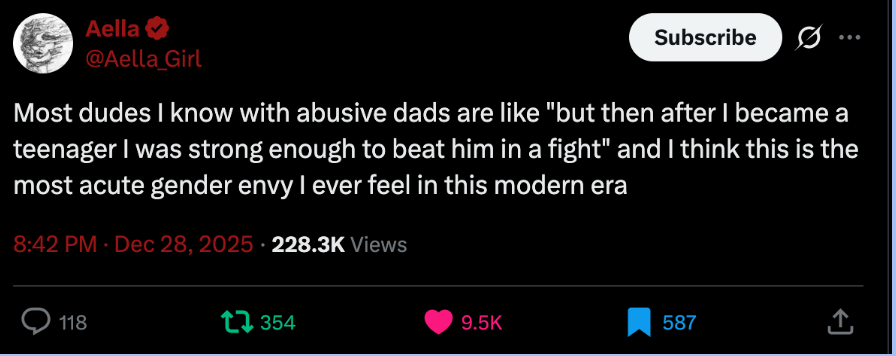
6. Almost forgot to add this glorious Aella tweet . I’ve never been this touched by a tweet before.
- Must be titled “Random Shit \#\ X”
- Must be posted by every Monday morning (before 12:00 pm)
Will probably add more rules in the future.
Friction-Maxxing
Had an interesting conversation in the group chat regarding short-form content, how bad it is, and alternatives that we all ought to consider. The linked article was sort of discussed, but its core was lingering in the background: friction-maxxing. The idea that particular technological solutions (hardware or software) to boredom and other frictions ought to be discarded and those frictions should be felt in their totality. Short-form content that can be found on Instagram or Youtube is a big example, but so is stuff like prompting chatGPT to generate new recipes–read a cook book instead!A more novel point made in that conversation is that you can’t be productive 100% of the time and trying to move away from low-energy content e.g. Instagram reels with more high brow hobbies like reading an academic textbook shouldn’t be more expected. The best course of action is to just find other types of content to consume and, in the long run, to find a nice balance between technology and the self. All of the things that were mentioned are at the end of this post.
One point made in the article that I do disagree with is that one ought to swear off of chatGPT or other LLMs completely. I use chatGPT for a small set of things that would be very costly otherwise (explaining difficult concepts in papers) and I don’t see that going away completely.
I think this issue of figuring out the best way to use your time is akin to managers within a firm figuring out the best thing a worker can do. However, here the manager and the worker are the same person, the profit motive is nonexistent and replaced with “discipline”, and the objective is a lot less clear.
Podcasts:
Critics at Large, Omnibus, Car Talk, This American LifeMy Favorite Theorem, Numberphile Podcast, Wait, Wait Don’t Tell Me
Podcasts w/ Descriptions:
Decoder Ring - it’s like pop culture and it goes into the history stuff behind it, really coolBoyfriend Material - 3 comedians answer relationship questions. They’re from rooster teeth before that got shut down.
Horror Virgin - this is just bc I love horror movies but it’s one guy who hates horror movies and the cohost makes him watch them and they talk about it
Last Podcast on the Left - it’s like the biggest true crime podcast, interesting stories and the guys are funny
If books could kill - they talk about and break down a lot of those like shitty Airport/self help books
History of Westeros - a game of thrones podcast that I like bc it mainly focuses on the books
Celebrity Memoir Book club - the title is pretty self explanatory, but they did a rebrand last year and I lowkey stopped listening
The name is Mamdani
It’s a new year and there’s a new mayor for New York City! Here are some of my favorite quotes from Zohran Mamdani’s inaugural speech as the newly inducted mayor of New York City. I’ll comment on a subset of the quotes.“For too long, those fluent in the good grammar of civility have deployed decorum to mask agendas of cruelty.”
“We will replace the frigidity of rugged individualism with the warmth of collectivism.”
I disagree with the point (more collectivism = good), but it’s so rhetorical! Additionally, a lot of people made the joke that this is what a villain in an Ayn Rand novel would say.
“We will transform the culture of City Hall from one of ‘no’ to one of ‘how?’”
Smallville
I have a really bad habit of binging a new TV show that I’ve seen clips of (or rewatching a show), but skipping through it just for the dopamine hit.It’s kind of dumb and most likely downstream of my short-form content addiction that’s become more prevalent.
Anyway, today, I started a new show called “Smallville”. It’s a Superman series from the 2000s that’s really different from any other television content of Superman that I’ve ever consumed. First off, it starts with when Clark’s a teenager and the first four of the ten seasons are just that; Clark’s a high schooler for the first four seasons and it’s a cheesy teenage comedy-drama show akin to the Gilmore Girls. However, the one catch is that the protagonist, Superman, has super powers!
What comes with that is that Lois Lane comes much, much later in the series and I’m left watching Clark interact with a bunch of side characters (apart from his parents and Lex Luthor) that, logically, can’t be present when he grows up. I don’t know if that’s completely true based on my prowling of reddit threads about Smallville. Now, onto what I like about the show.
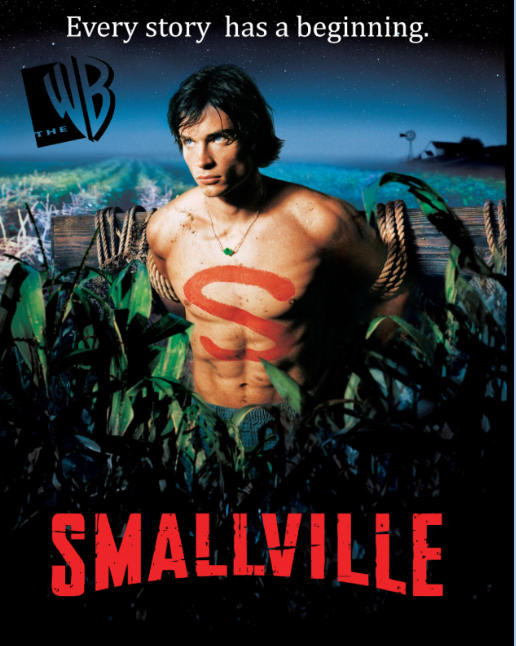
The first episode was awesome. There was so much foreshadowing that signaled to me that the creators of the show really cared about Superman. The main “tension” of the pilot was that Clark gets tied up like a scarecrow by the football team and a capital “S” is spraypainted on his bare chest (oh yeah, he’s stripped to his boxers). It took me a good minute to realize this was the showrunners referencing Superman’s traditional suit. An interesting bit of irony is that Lex, who works in Smallville as the manager of one of his father’s/Lex Corp’s fertilizer plants, is the one that saved him. Clark and Lex going from friends to enemies excites me a lot since you don’t generally see the former.
One part of the show that annoys me is the kryptonite-infested meteor strike (that brought Clark to Earth) being used as a plot device to create a new “Villain of the Week” for the first three episodes. Reddit tells me this will be the case for the rest of the first reason. It’s tacky and I foresee myself becoming annoyed by it and also all of the logically weak reasons for why Clark’s powers aren’t discovered sooner when stopping these villains.
Apart from that criticism, I’m curious as to how the showrunners will use the premise to develop Clark’s character. His parents are incredible and his community has enough evil and good-doers to really test Clark. By starting when he’s a teenager, the writers have a lot of ways to explore just how this boy develops into what we all know him as: Superman.
Man arrested for planting IEDs near capital right before Jan 6th
I completely forgot about this. I recall intensely following the court cases surrounding Jan 6th in 2023-2024, combing through hundreds of pages of legal documents and articles to get a better sense of what happened, and even reading through Jack Smith’s final special counsel report. In retrospect, it was probably a waste of time, but here we are again: reading up on criminal acts related to Jan 6th.Once he confessed to planting the bombs, the court papers said, Mr. Cole explained to investigators how he did it. According to the papers, he said that he had made the explosive powder in the devices using “charcoal, Lilly Miller sulfur dust and potassium nitrate that he purchased from Lowe’s.”
Below are two pictures of the two IEDs, which I just now learned was short-hand for "improvised explosive device”. I didn’t read through the entire document, but the perpetrator definitely acted alone and everything was done in an incredibly DIY way.


A Call for New Aesthetics
There will not be singular answers to these, but we are very interested in attempts to answer the questions. In particular, we would like to fund some artists who are thinking about them.
Grant size: $5k – $250k. Deadline: Applications are open until March 31, 2026.
Essay about chatGPT, work, and meaning
You don’t even hear the old folks wishing they could go back fifty years—in those days it wasn’t so easy to be sure of a meal. For many, it’s better this way, not the best it could be, but still better, even as they grieve what they stand to lose and what they’ve already lost.
The grief I feel, imagining a world without needed work, seems closest to this kind of loss. A future without work could be much better than ours, overall. But, living in that world, or watching as our old ways passed away, we might still reasonably grieve the loss of the work that once was part of who we were.
Christmas!!!!
I’m pulling an all-nighter the morning of Christmas. It is currently 12:50 am. I’m just going to dump things I’ve read that are Christmas related. Or, on second thought, anything I read is fair game.Okay, I went to sleep at 4 am. This will now contain all of the articles I choose to write about on Christmas day.
Court cases settled on Christmas day
Here’s an excerpt from this article detailing some of the content of these cases.
Surely only Ebenezer Scrooge could rule that it’s theft to take one’s own money. Or ruling that a construction project for a donut shop was an impermissible expansion of a preexisting nonconforming use. Taking away donuts on Christmas. Really?!
And only someone with a heart two sizes too small could have authored Zirinsky v. Carnegie Hill Capital Asset Management ordering the removal of children’s playground equipment as exceeding an easement. Did you hear what I heard? Ordering a playground removed on Christmas. You’re a mean one, Mr. Grinch!
Christmas is a Sad Season for the Poor
Russian sabotage is insane
First, a graph!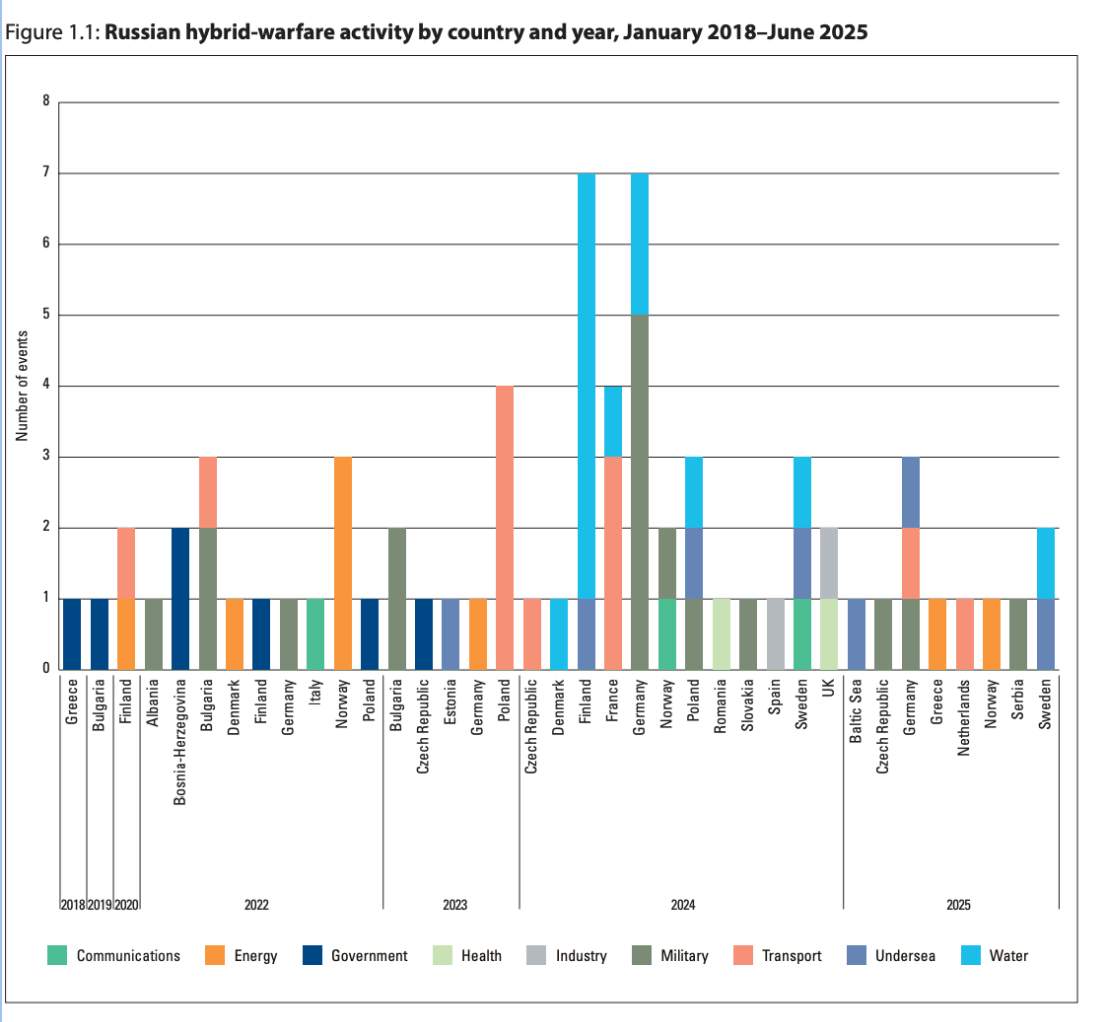
Before I get into the new things I learned, I just have to say that I hate national security briefs. Half of the text in any brief isn’t necessary and it never contains any quantitative information beyond counts of stuff like the graph above. I understand there are clear data limitations and that the authors of these briefs aren’t data scientists. But c’mon, I want cool arguments that leverage satellite data to make quantitative claims about the amount of harm caused by particular state acts.
Anyway, first off, I learned about some more Russian assassinations throughout the war. In Spain , a Russian pilot by the name of Maxim Kuzminov was found dead in February of 2024. He apparently defected to Ukraine in 2023.In Germany , the CEO of Rheinmetall, the largest German manufacturer of artillery shells, was targeted by Russia (obviously) last year in July of 2024. I feel sort of stupid for not remembering this, but I will now for the rest of time!
To wrap this up (I didn’t particularly enjoy this article), I think I’ll pay a bit more attention to Russian sabotage events. I never really paid attention in the past since it’s mostly blah blah blah infrastructure yada yada underwater fiber optic cables: super abstract stuff (half-joking when I say this).
But this excerpt did stand out to me.
These devices exploded at DHL logistics hubs in Germany, Poland and the UK and were test runs for potential future attacks against cargo aircraft.46 About 40 arson plots have been linked to Russia in Germany and Poland, including the destruction of the Warsaw shopping centre.
Last point, but the summary of policy advancements and insights at the end felt lackluster.
Chinese Peptides
I feel like I’ve been hearing about these things since late November, but they seem to have been a thing starting a bit earlier this year according to this SF Standard article.Ji’s stash didn’t come from a pharmacy but from a Chinese peptide dealer she’d been connected to on WhatsApp by tech friends. She paid the guy $195 for 10 vials. “Three weeks later, it shows up at your door,” she said.
Is the consumer basis somehow different since they’re from SF? Probably, but in the sense that they’re more open to injecting Chinese peptides in the first place. I would assume that a percentage of consumers are vain/insecure and that can be attributed to the startup-AI-industrial complex that has a lot of cultural sway among younger tech workers, but, again, there are huge benefits with seemingly low costs.
Mathematical modeling in biology
I thought I would have a lot more to say about this essay, but I can barely understand biology! Here’s my favorite excerpt of the pages I did understand.‘Models in analytical pharmacology are not meant to be descriptions, pathetic descriptions, of nature; they are designed to be accurate descriptions of our pathetic thinking about nature’.
Just substitute ‘systems biology’ for ‘analytical pharmacology’ and you have it. Black went on to say about models that: ‘They are meant to expose assumptions, define expectations and help us to devise new tests’.
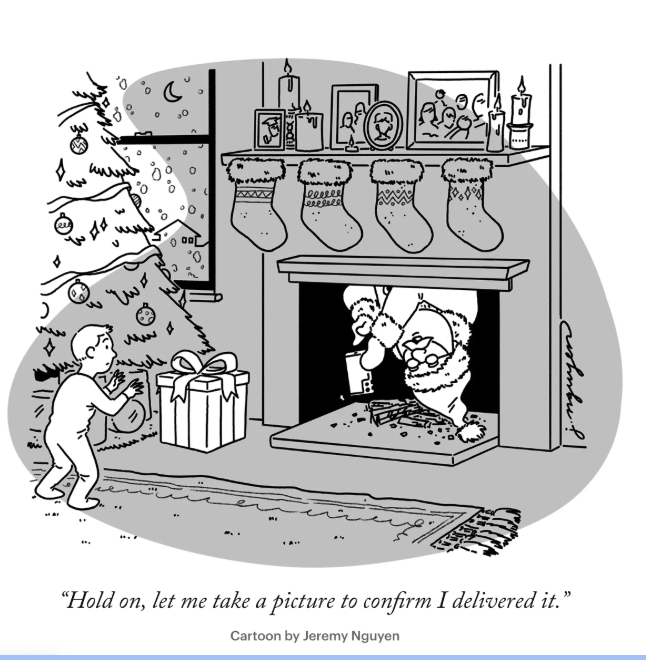
Christmas Day New Yorker Cartoon
Lessons From Modern Parenthood From Rahm Emanuel
[...]
Better yet, I gained from Ilana’s choice some unexpected leverage. By revealing her ploy to all her many friends in this article, I am, years later, teaching her a lesson I once feared she might never learn: Revenge is a dish best served cold.
During my childhood, my mother insisted that our family convene at a circular table without a head so that everyone would feel an equal right to speak and be heard… But my parents believed that open debate was the best way for us to learn and gain confidence. Amy and I continued that tradition with one update: We banished screens from the table. The point was to interact, even if you were too young to talk, or too much of a teenager to care what your moron parents had to say. The meals paid a dividend.
The well deserved demise of the Heritage Foundation
From Top Heritage Officials Flee to Mike Pence’s Nonprofit as Think Tank Fractures:“Why these people are coming our way is that Heritage and some other voices and commentators have embraced big-government populism and have been willing to tolerate antisemitism,” Pence said.
Among those joining AAF are John Malcolm, the head of the foundation’s legal and judicial studies center, Kevin Dayaratna, the head of the foundation’s data analysis center and Richard Stern, the director of the foundation’s economic policy studies institute. AAF said it is bringing on about a dozen other staff members. Malcolm is taking seven members of his center’s team.
On the donor front, it seems like they’re moving away from Heritage in favor of AAF (Advancing American Freedom).
“President Trump’s term is coming to an end. The Republican Party is not going to see really a primary among candidates but a primary on principles and fundamental policies,” he said.
AAF said it was able to raise more than $10 million in a few weeks to make the new hires
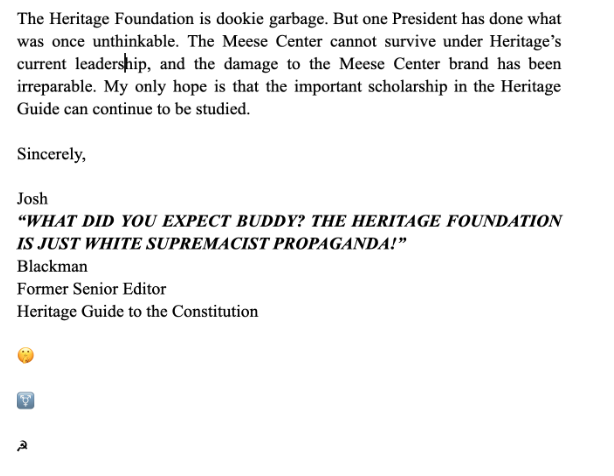
Oh shoot, I almost forgot to mention this, but here’s a letter from Josh Blackman (who resigned from the Heritage Foundation) making it explicit that this divide is due to rightist antisemitism.
As Senator Ted Cruz observed , "this poison of antisemitism on the right . . . is spreading with young people."
I agree with Ben Shapiro : "If the Heritage Foundation wishes to retain its status as a leading thought institution in the conservative movement, it must act as ideological border control." Antisemitism is always the canary in the coalmine. History teaches us that any society that fails to protect its Jewish people is destined for despair.
Warren Buffet is sort of cool!
This was a really refreshing article to read. It was written by Seth Klarman, another value-investor, and it’s a piece about Warren Buffet’s retirement and his life.2. Simplicity of thought, getting right to the heart of the matter in analyzing each investment.
3. The ability to distinguish good investments from bad ones, and great investments from merely good ones—and the insight and conviction to stick with the best ones over time. Buffett, to paraphrase the investment guru Peter Lynch, never cut his flowers or watered his weeds.
4. The ability to stay focused over long periods and avoid distraction.
5. The mental agility to alter his strategy when he found a way to improve, such as when he came to more significantly emphasize the quality of a business in his decision making.
Simplicity is also highly valued in, at the very least, non-hard STEM fields e.g mathematics, computer science, etc. Being able to get to the heart of a proof or theorem is a sign of a high mathematical maturity and (2) is valuing just that, but in a completely different setting.
Point (3) feels more easily applicable to fields that are under the umbrella of applied math. This sort of thinking is highly-valued in economics. Being able to see through the data, synthesize it with theory, and all in service to make a profoundly new insight into the world is hard and very few people in this world can do that consistently at a high level of quality.
(4) and (5) are, again, common virtues within academia that point to an academic’s quality.
Cool Website About Jobs and Incomes
From Crémieux.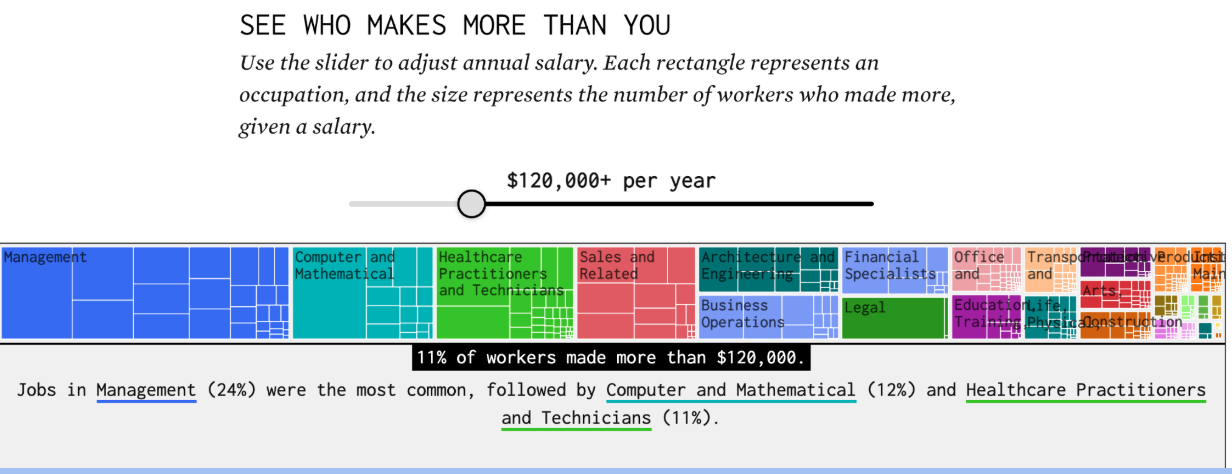
To clarify, this is the share of people who make an income and so children, the elderly, and disabled aren't included in the above.
This is also from the author of the article, which summarizes some of the data, which is from the five-year American Community Survey for 2023.
At $45,000 per year, half of workers make more. The share of workers who make more decreases quicker with higher thresholds. At $100,000, only 16% of workers make more. 4% of workers make more than $200,000.
The final 1% makes more than $520,000. While the categories — management, healthcare practitioners, and sales — seem about right, I am curious about the less typical jobs, such as cashiers and elementary school teachers who reported making more than half a million in salary. I suspect these are directors and managers who do more than manage. Or it could just be noise. I’m betting the former.
The Data on Self-Driving Cars Is Clear. We Have to Change Course.
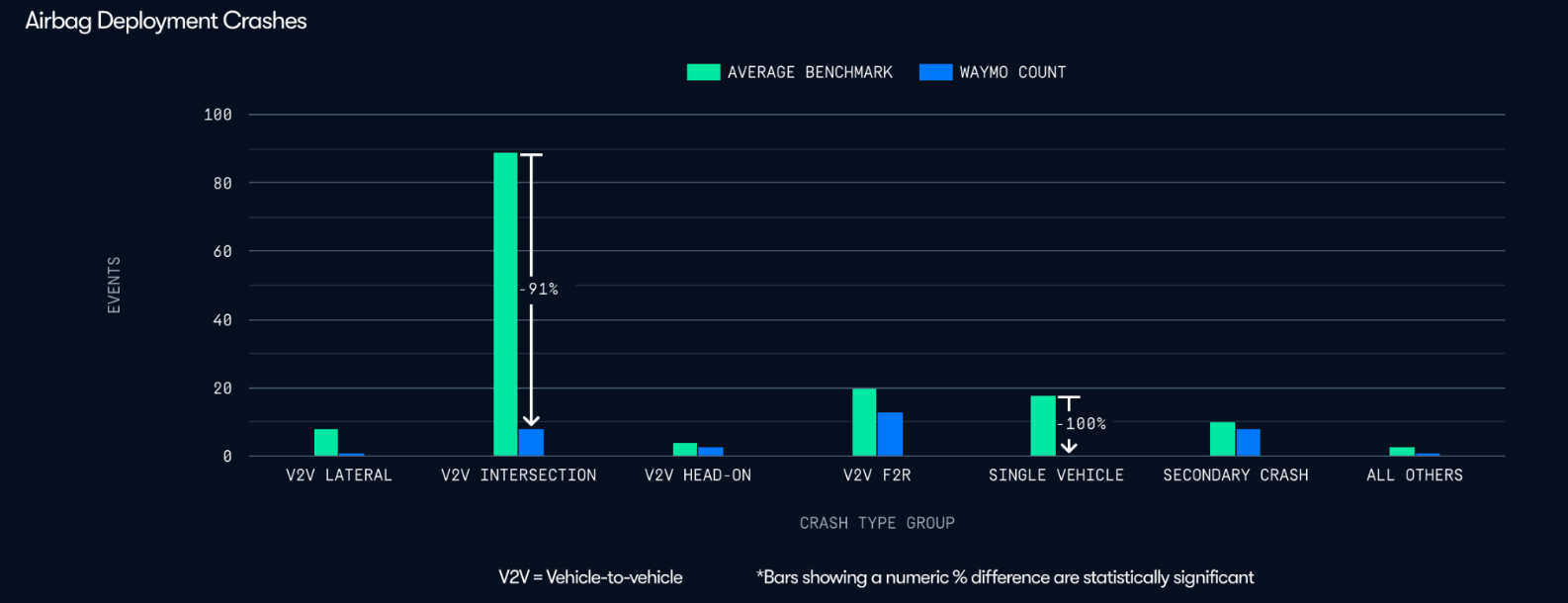
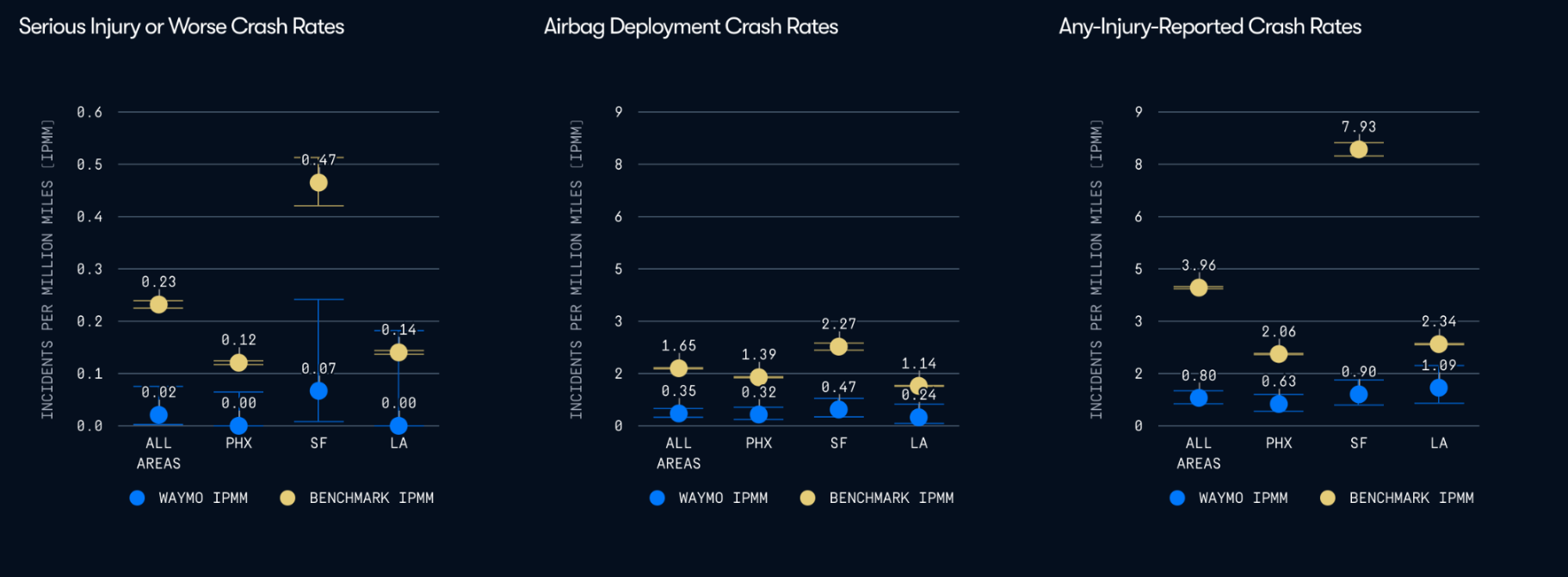
The link is a NYT article that has a pretty good exposition on Waymo’s data. I’m just going to copy
and paste some graphs from Waymo's original article and
call it a day.
The most jarring bar is the one for differences in crashes at intersections.
For some reason, the article only includes the average across all cities, but San Francisco is weirdly
unsafe relative to even LA. I wonder why that’s the case.
Lior Pachter Dunks on Watson
The Cold Spring Harbor Laboratory created an obituary for James Watson who died a month ago (November 5th). I’ve never heard of CSHL before, but apparently they’re a big deal. Anyway, Pachter just dunks on Watson with his comments (in red) and here are some excerpts of his commentary.
Watson, along with Crick and Wilkins were awarded the 1962 Nobel Prize in Physiology or Medicine. Watson also received the Presidential Medal of Freedom from President Gerald Ford and the National Medal of Science from President Bill Clinton, among many other awards and prizes.
It is true that Watson received these awards. Coincidentally, William Shockley was also awarded the Nobel Prize around the same time as Watson (physics, 1956) and he promoted racist eugenics, arguing that people of African Ancestry posed a “dysgenic risk”, as well as advocating for sterilization. He used his Nobel prestige to advance his malicious and scientifically bankrupt ideas (source: Scott Rosenberg, 2017)
He portrays Watson as not as intelligent as his awards make him out to be, a dick, and a race realist. Ronald Fischer was sort of a race realist and a dick, but a genius within statistics. Watson, from my limited understanding of him, seems to be like Ronald Fischer, but just worse in every way. He also just seemed to be particularly petty especially against other women within biology e.g Rosalind Franklin.
As an author, Watson wrote two books at Harvard that were and remain best sellers. The textbook Molecular Biology of the Gene, published in 1965 (7th edition, 2020), changed the nature of science textbooks, and its style was widely emulated.
In this textbook Watson got the central dogma wrong, presenting it in a profoundly misleading way. (source: Matthew Cobb, 2024).
But on pages 1209 and 1211 of this issue of Nature, Baltimore and Mizutani and Temin claim independently that RNA tumour viruses contain an enzyme which uses the viral RNA as a template for the synthesis of DNA and thus reverses the direction of genetic transcription.
Now, I’m not too sure of Pachterß's point. I can’t find a copy of the original 1965 book since later editions have presumably been updated accordingly. However, I did easily find a copy of the seventh edition, which ßcontains theß following sentence on page 41.
This sentence is out of context since this is what was written on page 33.
In 1956 Francis Crick referred to this pathway for the flow of genetic information as the central dogma:

The arrow between DNA and RNA indicates that RNA synthesis (called transcription) is directed by a
DNA template. Corre- spondingly, the synthesis of proteins (called translation) is directed by an RNA
template. Most importantly, the last two arrows were presented as uni- directional; that is, RNA
sequences are never determined by protein tem- plates nor was DNA then imagined ever to be made on RNA
templates.
However, as we will see in Chapter 12, RNA chains sometimes do act as templates for DNA chains of
complementary sequence. Such reversals of the normal flow of information are very rare events compared
with the enormous number of RNA molecules made on DNA templates.
I think the authors of the seventh edition essentially pulled that diagram from Crick’s original
thought process (found through Cobb’s article), which is pretty interesting.
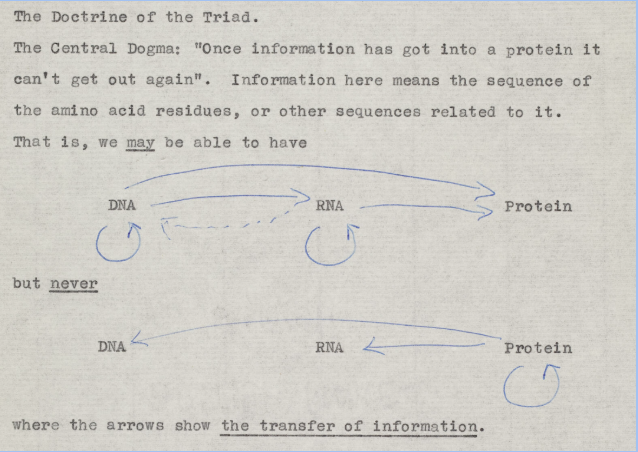
From everything I’ve read so far, it seems like a lot of people misinterpreted what Crick’s intentions were, so I don’t think this is that big of a deal. It seems like the book has had a net-positive impact on people and especially due to all of the lovely people who continually created newer and better editions of it.
The Double Helix (1968) was a sensation at the time of publication. Watson’s account of the events that resulted in the elucidation of the structure of DNA remains controversial, but still widely read.
Prior to the publication of The Double Helix, Francis Crick wrote that “If you publish your book now, in the teeth of my opposition, history will condemn you”. Watson published the book anyway (source: letter by Francis Crick, 1967) .
This is another point, which, on the surface, seems like a straightforward dunk, but actually has a
much more interesting story. The point Pachter is implicitly making is completely true: Watson’s
account of the discovery of the structure of DNA in the original 1968 autobiography and Crick very
much condemned him at the time. The Double Helix is quite inaccurate and is a very personal account of
every event and of other people’s involvement.
The canonical example everyone refers to is Rosalind Franklin who is consistently referred to as
“Rosy” . There were tensions
between her and Maurice Wilkins (another person who shared the Nobel with
Watson & Crick), but Watson describes Rosalind as being too assertive as a woman and blames her lack
of femininity for the issues between her and Wilkins.
The following excerpt is from page 13 of Gunther Sten’s 1980 Norton Critical Edition of The Double
Helix, which, alongside the original book, contains a lot of material that contrasts with Watson’s
view.
[...]
There was never lipstick to contrast with her straight black hair, while at the age of thirty-one her dresses showed all the imagination of English blue-stocking adolescents.
So it was quite easy to imagine her the product of an unsatisfied mother who unduly stressed the desirability of professional careers that could save bright girls from marriages to dull men. But this was not the case.
Berkeleyite or Berkeleyan?
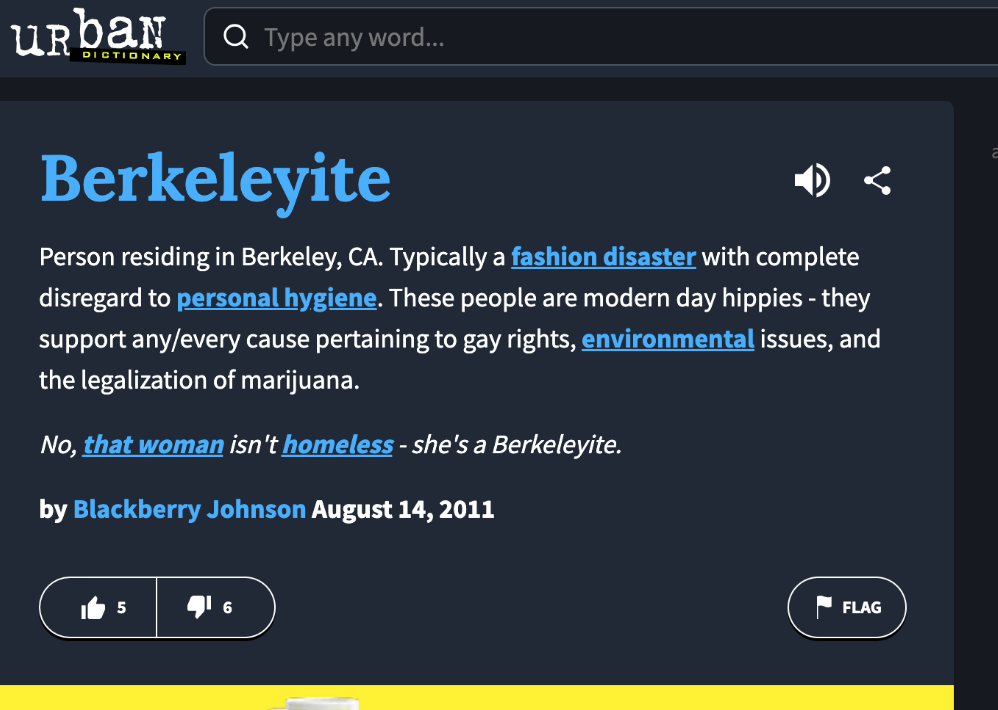
Oddly enough, Urban Dictionary only has a record from 2011 of Berkeleyite (Berkeleyside article was published April 2011). “Berkelyite” is pretty lame, but “Berkelite” looks/sounds a bit better.

Grad Student's Thoughts: My First PhD Semester - The Good, the Bad, and the Ugly
Anyway, right before our midterm and right after, he emphasized this to each and every person in that class and I’m glad he did. I didn’t score as well as I had wanted (earned a B), but his reassurance that we all deserved to be there did put a smile on my face when we received our grades for that midterm a week later.
“Alright. You’ve managed to weasel your way through so far. Now’s the moment they finally uncover that you’re a fraud.”
This is a quote from her advisor.
I’m kind of lazy, so here are two other excerpts that are quite interesting.
Rest isn’t indulgent, it’s preventative maintenance. Because if your priority is the work, then every other potential stressor - physical discomfort, exhaustion, poor sleep, hunger, isolation — needs to be softened, minimized, or removed.
Open Source Project that Discovers Blogs!
Source: Statistical Modeling, Causal Inference, and Social Science
Sermet Pekin writes: I built an open-source project that discovers blogs through recursive network exploration–basically PageRank for the blogosphere. Your blogroll was the main seed source.It recursively discovers new blogs by following citations and parsing RSS feeds, mapping out how blogs link to each other. Starting from a curated seed list (I used your blogroll recommendations), it can scale to hundreds or thousands of blogs depending on exploration depth. It supports different exploration strategies—breadth-first to explore widely across communities, depth-first to dive deep into niches, or mixed approaches.
I thought you might find it interesting: – Helps surface quality blogs without relying on social media algorithms – Your blogroll made excellent seed data—the blogs were well-curated and interconnected Fun!
Free Riding in Mobile Ecosystems
This article is from the International Center for Law & Economics and I don't really pay attention to
antitrust stuff, but this article seemed pretty interesting. The subject of the article is the
European Union's Digital Markets Act (DMA, 2023), which forces "gatekeepers"-think Apple and Google-to
allow for alternative in-app payment processing and app stores on their mobile operating systems.
Here's an
article
with some examples of alternative app stores that are allowed in the EU
Source: Brian Albrecht (Chief Economist) & Dirk Auer (Director of Competition Policy)
The EU’s Digital Markets Act (DMA) and similar regulations around the world require designated “gatekeepers” to open their mobile operating systems to third-party app stores and sideloading. They also typically include requirements that developers be allowed to use alternative in-app payment systems and to “steer” users toward purchases outside the app store.Now, if one forces app stores to allow developers to contract alternative payment processors (think PayPal or Venmo) then developers would be able to keep more of their revenue and free ride off of the investments of all of those alternative app stores. Additionally, these alternative app stores would themselves be relying on OS-level infrastructure (discovery, security, etc.) and be free riding off of Apple's investments. This would lead to underinvestment in what makes the Apple app store work reasonably well in the first place e.g fraud protection, curation, advertising, etc.
Source: Brian Albrecht (Chief Economist) & Dirk Auer (Director of Competition Policy)
Alternative payments and steering compound the problem. Developers can use the store’s discovery and curation infrastructure to acquire users, then route purchases through lower-cost payment channels. The store still bears the cost of matching users and developers but loses the revenue that justified that investment.Source: Apple
Developers operating under the Alternative Terms Addendum for Apps in the EU have the option to distribute their iOS and iPadOS apps in the EU via the App Store, Web Distribution, and/or alternative app marketplaces. They can also use alternative payment processors in their apps in the EU on the App Store across Apple operating systems. The CTF only applies to apps downloaded by EU users on devices running minimum of iOS 17.4 and iPadOS 18.[...]
Fee for each first annual install over one million. Developers pay a CTF of €0.50 for each first annual install over one million in the past 12 months.
Game Theory and the First World War
Not completely sure where I found out about this article. It probably was from Marginal Revolution. Regardless, here's an excerpt that gave me a bit more insight on the art of game theoretic modeling.
Source: Journal of Economic Literature, Roger Myerson
One of the triumphs of Fearon’s approach is his demonstration that a preventive war by a currently dominant nation against a rising nation, such as Germany contemplated against Russia in 1914, can be understood in terms of moral-hazard commitment problems in a dynamic game.[...]
The key to this analysis is that the rising nation cannot credibly commit itself now to refrain from using its ability to threaten war in the future after power has shifted in its favor, but the currently dominant nation could prevent this shift of power by launching a costly war now.
Source: Journal of Economic Literature, Roger Myerson
As Wolford rightly argues, we can gain important insights into the problems of war when we try to explain leaders’ choices as rational decisions in terms of natural human values. But what would happen if we tried to rationalize a surprising decision that was actually a mistake? The surprising move could be rationalized in a Bayesian game by hypothesizing that the decision maker has an unusual type with preferences or beliefs that would induce such behavior[...]
Thus, Germany’s surprising invasion of Belgium in 1914 could cause people in Britain to infer that Germany had aggressive expansionist leadership, while people in Germany might consider such beliefs to be unjustified British prejudice.
ELOISE LIKES MAKING THINGS
This person's website is pretty interesting. I found out about it from this article about sex. Her twitter account is linked in the third footnote. Below are some excerpts from the writing section that I thought were cool.
Source: 'Appreciation'
When walking outside I sometimes get a sense of appreciation for how paradise-like my surroundings are.I walk to the park near my home. A park! How absurdly utopian it is that we’ve fenced off an area that’s sole purpose is just to be nice. In the park there are pigeons waddling around fat on French fries, because food is so abundant that people are sometimes careless with it. (And French fries exist! Transcendent deliciousness beyond a cave man’s wildest dreams.)
Source: If I were a billionaire
If I were a billionaire I would hire someone well-acquainted with my tastes whose job it is to print out tweets I'd enjoy and hand them to me on paper,so I can't see bad comments and can't get sucked into browsing twitter.
The University of California knows its stereotypes. How does college football fit in?
This article was pretty interesting. I don't follow football (certainly not college football), but how our (Cal's) team changes after the devastating loss at the big game is sure to be interesting. Putting that aside, this quote is pretty funny without sufficient context.
Source: The Athletic (NYT)
“I think that’s very much the ethos now: Everybody has to do their part to save Cal football,” Kranz said. “We have to turn to communism to save Cal football, not out of ideology, but out of desperation. A lot of this effort is about trying to preserve something that is a unifying sense of community for the campus when we don’t have a ton of those things here.”Mapping the future with 3D-printed titanium Apple Watch cases
Source: Apple
This year, all Apple Watch Ultra 3 and titanium Apple Watch Series 11 cases are 3D-printed with 100 percent recycled aerospace-grade titanium powder, an achievement not previously considered possible at scale.